How to Order Pintxos
Stand, get heard, read the board behind the bar, keep your toothpicks, pay before you leave, move on. The whole ritual in the order it happens.
The ritual is simple and completely unexplained to anyone arriving for the first time. Here it is in the order it actually happens.
1. Walk in and stand
There will be tables. Ignore them, or accept that using them changes the evening — table service is slower, sometimes costs more, and is not where the bar’s attention is.
Go to the bar and stand. Crowded is normal and good. If the bar is three deep at 9pm on a Friday, that is the bar you want.
2. Get the bartender’s attention
Not by queueing, because there is no queue. Not by waving.
Make eye contact and be ready. Basque bar service is fast, direct and completely unbothered — the bartender will scan the bar, catch your eye, and expect you to say what you want immediately. Hesitating loses your turn, which is not rudeness on anyone’s part, just the pace.
Have your order ready before you catch their eye.
3. Look at the board, not just the counter
This is the whole difference between eating well and eating fine.
The counter holds the cold pintxos: prepared in advance, laid out, help yourself. They are good and they are not the point.
Behind the bar there will be a chalkboard or a short printed list of hot, made-to-order pintxos. That is what the bar is known for. It is usually in Spanish or Basque, it is usually short, and it is almost never translated.
If you can only manage one sentence in Spanish, make it: ¿Qué me recomienda? — what do you recommend. Bartenders here answer that question honestly and it will get you the right thing.
4. Order one drink, small
The convention is a zurito — a small glass of beer, a few mouthfuls — or a glass of txakoli, the local dry, slightly sparkling white, which the bartender will pour from a height to open it up. Basque cider gets the same theatrical treatment.
Small is correct. You are having one at each of five or six bars.
5. Keep your toothpicks
Every cold pintxo comes pinned. Leave the toothpicks on your plate. That is how you get billed: the bartender counts them.
Do not throw them on the floor. You will read that this was traditional in old bars; in San Sebastián today it mostly means nobody can work out what you owe.
6. Pay, then leave
Pay at each bar before you move on. Nobody runs a tab across a pintxo crawl, and the bar is turning over its whole standing room every twenty minutes.
Then go. One or two pintxos, one small drink, next bar. That rhythm is the entire form.
What to avoid
Sitting down for the whole evening. The most visible tourist behaviour in the Parte Vieja, and it means you eat one bar’s version of everything instead of five bars’ best thing.
Ordering six things at once. You are not building a meal at this bar. You are having its speciality.
Going at 6.30pm. The counters have not been restocked and the room is empty. Bars fill from about 8pm and the crawl runs late.
Being polite to the point of invisibility. Waiting quietly at the back is how you stand there for twenty minutes. Get to the bar.
The two-word version
Stand, and move on.
Everything else follows from those. If a guided evening sounds like the faster route to knowing which bar to move on to, the verdict on tours is honest about what it does and does not buy.
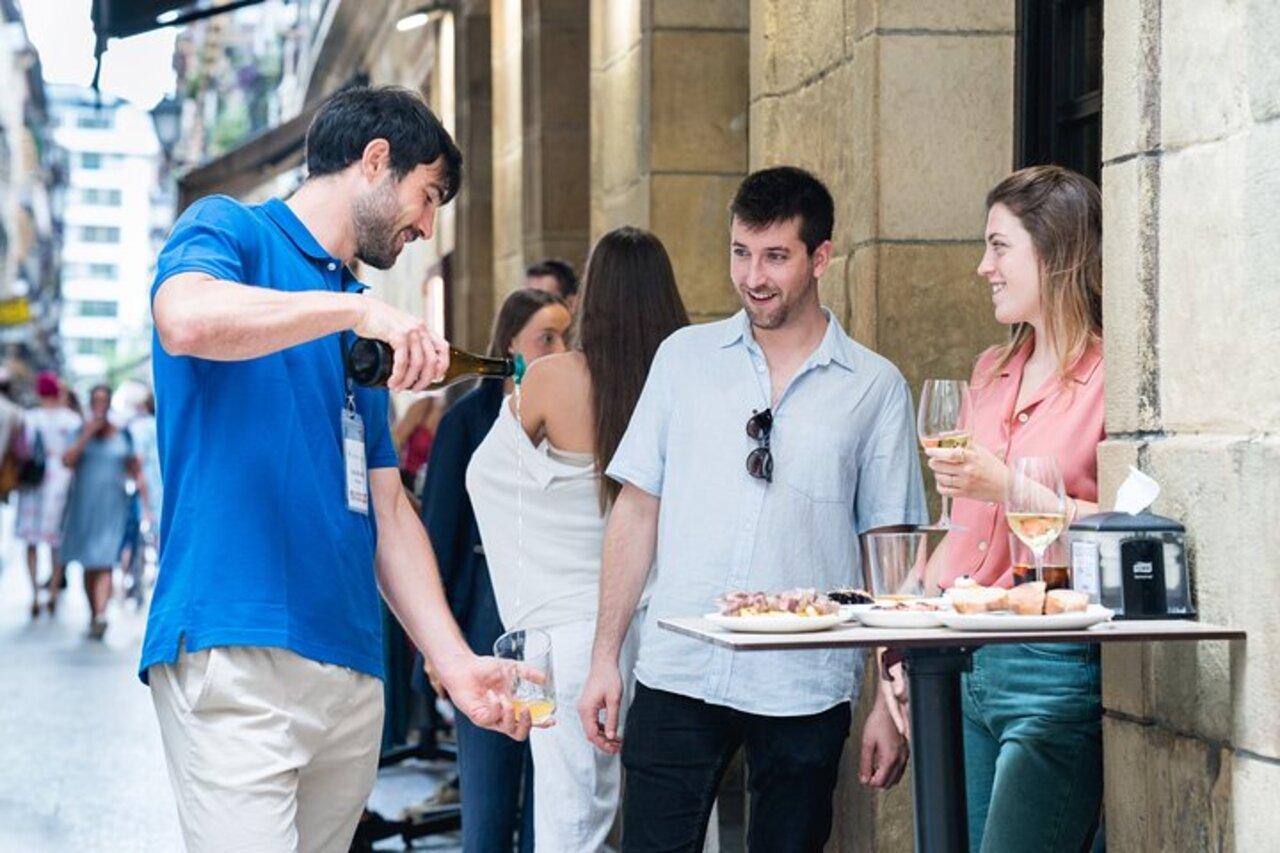
Book a San Sebastian Food Tour
The pintxo tasting paired with wines, rated 4.8 by 750 guests. Small groups, several bars in one evening, and a guide who orders the thing each bar is actually known for. Instant confirmation and free cancellation up to 24 hours before.
Check Availability & Book